

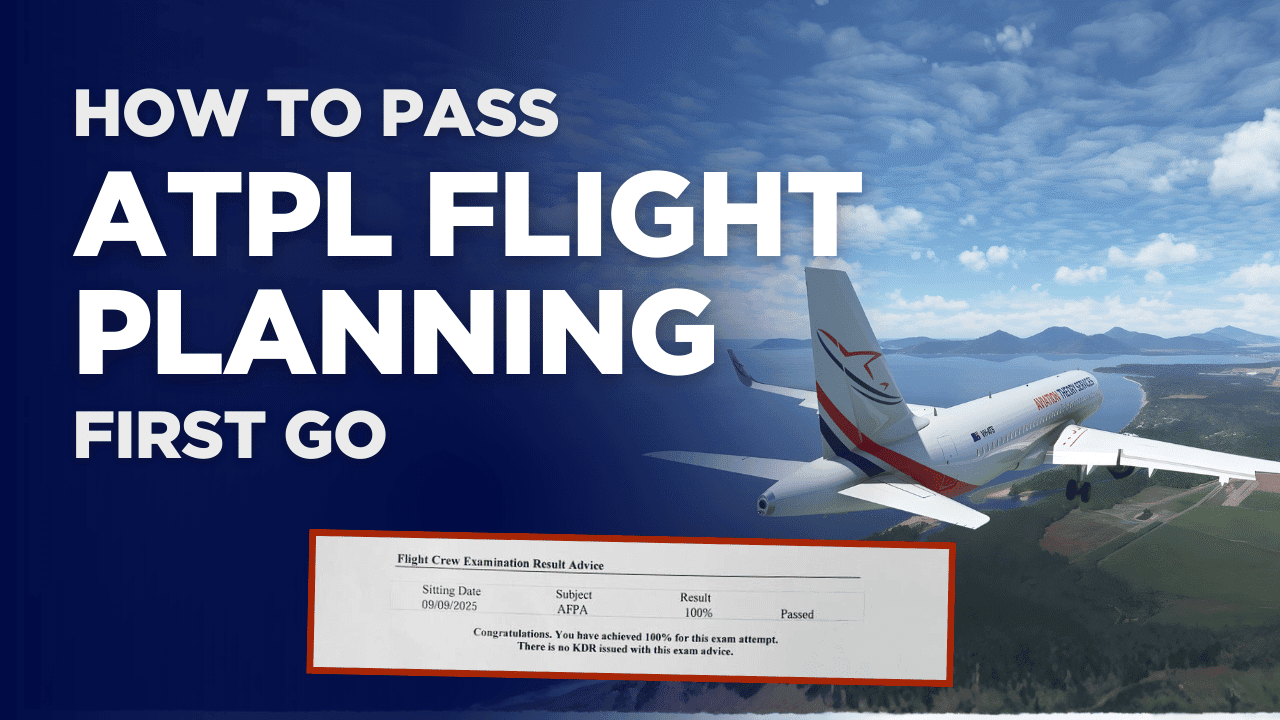
2026: Passing ATPL Flight Planning First Go
I truly, 100% believe that everyone can pass ATPL Flight Planning on their first attempt.
Not because it’s easy. It isn’t. But because it is simple.
Flight Planning is a procedural exam. You follow specific, repeatable procedures and if you apply them correctly, you get the right answer. There is very little subjectivity. Most failures are not caused by lack of ability, but by skipped steps, mixed techniques, or poor preparation structure.
If you follow the process outlined below properly, you should never walk into the exam room hoping to pass. You should only be sitting the exam when you know you will pass. Our readiness exam exists to prove that.
Step 1: Work Through the Entire Textbook and Video Series
Start at the beginning. Finish at the end.
-
Read the textbook properly
-
Watch every explanatory and worked-answer video
-
Complete the textbook examples as you go
Once you reach the end, return to the table of contents and go through it section by section.
For each topic, ask yourself:
“If this appeared in the exam tomorrow, could I apply the procedure correctly without guessing?”
If the answer is anything other than a confident “yes”, that topic is not finished.
Do Not Skip Topics You Think You Already Know
This is where many students quietly lose marks.
Commonly skipped areas include:
-
Whiz wheel fundamentals
-
ETAS
-
wind component logic
These are procedural areas. If you skip or rush them, mistakes will appear later on. If you think you already know something, prove it by doing it properly.
Step 2: Complete the Procedures Quiz Before Any Practice Exams
Before starting Exam 1, complete the procedures quiz.
This step is essential.
The procedures quiz asks you about the rule/ procedure without the noise of an exam question. Flight Planning rewards correct sequencing and method. If your procedures are weak, practice exams will simply reinforce bad habits.
If you struggle with the quiz:
-
Go back to the textbook
-
Re-watch the relevant videos
-
Fix the procedure before moving on
Only once procedures feel automatic should you start the practice exams.
Step 3: Use the 5 Practice Exams as a Training Sequence
The practice exams are not there to see how you go. Each exam has a specific purpose and should be treated as part of a progression.
Exam 1: Build a Solid Foundation
Focus: Accuracy and correct method
-
No time pressure
-
Use the textbook, summary sheets, and videos
-
Confirm every step is correct
Review thoroughly. Understand every mistake and redo incorrect questions.
Exam 2: Strengthen Your Memory
Focus: Reducing reliance on references
-
Still untimed
-
Work from memory where possible
-
Look things up if unsure, rather than guessing
Fix weak areas before progressing.
Exam 3: Closed-Book Practice
Focus: Understanding without support
-
No textbook or notes
-
No time limit
This exam highlights whether you truly understand the procedures or were relying on references.
Exam 4: Introduce Time Pressure
Focus: Exam-like conditions
-
Closed book
-
Three-hour time limit
Analyse mistakes carefully and revisit weak areas before moving on.
Exam 5: Full Exam Conditions
Focus: Realistic final preparation
-
Closed book
-
No pauses
-
Strict three-hour time limit
This should feel controlled and methodical. If it doesn’t, go back and fix the gaps.
Step 4: The Final Exam: Your Readiness Check
The final exam exists to answer one question. Are you ready to book the real exam?
Sit it under strict conditions:
-
No notes
-
No breaks
-
Three-hour time limit
Benchmark:
-
80% or higher. You are ready to book.
-
Below 80%. Do not book yet. Revisit weak areas and repeat the process.
You should not be booking the real exam unless the final exam confirms you are ready.
Don’t rush to the final exam. Your first final exam attempt is the most honest indicator of your real exam result (usually within 2% of each other). After that, familiarity with the questions begins to replace genuine procedural understanding.
Stick to One Complete, Current Course
If you are serious about passing ATPL Flight Planning, you need to do it the right way.
That means:
-
using a trusted, current course
-
avoiding shortcuts
-
not mixing multiple providers or outdated material
Using illegal or shared copies of textbooks is a common mistake. These are almost always out of date and often contain procedures, assumptions, or tables that no longer align with CASA expectations.
Similarly, using other theory providers’ notes or practice exams often causes problems:
-
Different methods for TAS, ETAS, and wind components
-
Procedures that do not match CASA’s interpretation
-
Extra content that is irrelevant to the exam
Each provider may be internally consistent, but mixing them leads to confusion and inconsistent technique.
Why ATS Works
The ATS Flight Planning course is:
-
exam-current and actively maintained
-
aligned specifically to CASA procedures and marking logic
-
consistent across textbook, videos, procedures quiz, practice exams, and final exam
-
supported by quick, trusted, exam-relevant instructor support
If you work through the ATS course properly, there is no requirement to use anything else. In practice, doing extra usually hinders, not helps.
Why This Approach Works
The five practice exams and final exam collectively cover everything you need.
If you have:
-
studied the textbook properly
-
locked in procedures
-
followed the progression correctly
then you do not need additional questions, extra providers, or external material.
If you feel the need for more content, it is usually a sign that something earlier was rushed or skipped.
Key Takeaways
-
Flight Planning is simple, not easy. Correct procedures produce correct answers.
-
Do not skip topics, especially easy ones (you might miss something fundamental).
-
Lock in procedures before touching practice exams.
-
Progress methodically from open-book to full exam conditions.
-
Stick to one current, CASA-aligned course.
-
Use the final exam as a gatekeeper, not a practice tool.
If you follow this process properly, you can almost guarantee a first-time pass. You should only walk into the exam room when you know you will pass. The final exam proves that.
